
Honoring Sayers

“She was the first person of importance who ever wrote me a fan-letter,” C.S. Lewis noted about Dorothy L. Sayers. “I liked her, originally, because she liked me; later, for the extraordinary zest and edge of her conversation—as I like a high wind.” I love the way Lewis described his relationship with Sayers. As a man who enjoyed long walks in the countryside, Lewis would undoubtedly appreciate a bracing wind, and that’s the comparison he made with Dorothy Sayers. A… Read more »

Stories from “Mere Christians”

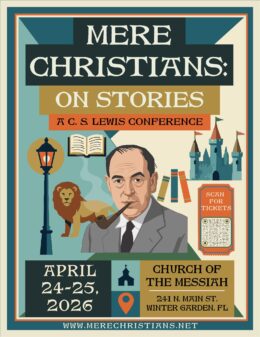
I just returned from Winter Garden, Florida, after being part of the “Mere Christians” conference for the third year in a row. Speaking for many, I’m sure, the draw of C.S. Lewis conferences, regardless of the sponsors of the event or the theme, is the opportunity to meet face to face with others who have the same abiding interest—and dare I say, fascination—in one of God’s premier writers of the past century. The fellowship of kindred minds and spirits is… Read more »

The Three Parts of Morality

C.S. Lewis’s classic, Mere Christianity, begins with a section entitled “Right and Wrong As a Clue to the Meaning of the Universe.” In it, he establishes that a universal moral law applies to all humans. Section two, called “What Christians Believe,” then goes into the specifics of Christian doctrine with its apex being the Person of Christ as Savior. The third section, “Christian Behavior,” begins with a chapter explaining “The Three Parts of Morality.” It forms the bedrock for all… Read more »

My God, My God, Why Have You Forsaken Me?”

Of all the words Jesus spoke from the cross, “My God, My God, why have You forsaken Me,” had to be the ones of greatest personal anguish. Why? What makes these words so searing? The key is the word “forsaken.” We must stop and consider the depth of this anguish and why it is so. In order to do this, we have to draw from the rest of Scripture the reason why this would be so devastating. The Father, Son,… Read more »

Arguing with God

“God created things which had free will. That means creatures which can go either wrong or right,” C.S. Lewis states in “The Shocking Alternative” chapter of Mere Christianity. He continues, “Some people think they can imagine a creature which was free but had no possibility of going wrong; I cannot. If a thing is free to be good it is also free to be bad.” This, of course, leads to the question of why God made such a choice in… Read more »

Language That Can Be Understood

One of the reasons I enjoy teaching about C.S. Lewis and sharing his thoughts is that he is so good at putting deep thoughts into words that should communicate well with almost any audience. One doesn’t have to be an academic to figure out what he is saying. In one of his essays, “Christian Apologetics,” he offers this guidance: He continues in that same essay with sound advice for anyone seeking to present Christian truth: “You must translate every bit… Read more »

Mere Christianity: Teaching a Classic

C.S. Lewis’s Mere Christianity has become a classic in the history of books explaining the Christian faith. I have begun teaching this classic at my church on Wednesday evenings. People can come in person, watch on Zoom, or watch the sessions later after the video is uploaded. The interest is high: 60 have now participated in the first session and others will undoubtedly let me know later that they have watched the first video. It’s a blessing to have this… Read more »